We would like to congratulate Dr. Kirsten McKenzie (MIRAGE lab Malayisa Campus) and husband Richard Fender on the birth of their baby boy. Rylan James McKenzie Fender was born in Malaysia just three weeks ago. He is doing really well, is incredibly cute, and surely a cognitive neuroscientist in the making?
Friday, 12 October 2012


Friday, 29 June 2012
June Quarterly Illusion - The Supernumerary Limb Illusion
‘Supernumerary’ means more than the usual number and in this simple illusion we decided to give people an extra arm. We have used our supernumerary limb illusion in several of our MIRAGE experiments (Newport et al. 2010, Newport and Preston 2011, Preston and Newport 2011a, Preston and Newport 2011b) and use it to instantly alter perception of the body.
Participants put their right or left hand into the illusion box and instead of seeing just one arm they see two. The two images of the hand can be positioned either with both images slightly offset to either side of the actual hand (as in Newport et al. 2010, Preston and Newport 2011a and b), or one image can be in the same location as the real hand with the other offset to one side (Newport and Preston 2010).
We usually then ask people to tap their finger up and down or to stroke a brush tip. When they see their hands move, we can either have both hands move together at the same time, or add a slight delay to one of them. When asked to identify which of the seen hands feels like their real hand, participants will nearly always go for the one moving in time with their real hand. The match between the planned movement and the timing of the seen movement creates a strong and immediate sense of ownership over the hand that moves in time (what we call the synchronous condition). We can then control feelings of ownership by manipulating which image moves in time with the real limb by swapping the delay from one hand to the other. The sense of movement (and hand) ownership instantly switches from the hand that used to be moving in time to the hand that is now moving in time. This strong feeling of ownership can then be instantly transferred to the other hand by swapping which of the images is synchronous... and back again…and again….and again! We could do this all day if we wanted to because the feeling of ownership does not seem to reduce regardless of the number of times it is transferred from one hand to the other, although this is a weird experience for the participant. Another weird experience occurs if we make both hands synchronous with the real hand simultaneously. Then participants claim ownership over both hands at the same time claiming that they have two right hands!
The transfer of ownership (and owning an extra limb) is a good illustration of how flexible our brains are in updating the representation of the body. This can help to inform us about the healthy brain, but also in understanding clinical populations when body ownership is disturbed.
Video of a participant experiencing The supernumerary limb illusion
Monday, 21 May 2012
Helen's trip to Australia
I have had the privilege of spending the last month working
in Lorimer Moseley’s Body In Mind lab in Adelaide. After recovering from the 34
hour flight, the jet lag and FINALLY being able to make a decent cup of tea, I
thought I would take the opportunity to share some of my experiences with you
(and believe me, there were many!). Aside from the obvious highlights of
hugging a koala and exploring in great depth the Adelaide Hills wine region
(twice), the experience I gained from working in the Body In Mind lab was
invaluable. While I was there, I learnt to use a laser to induce experimental
pain in healthy participants, and was involved in a study looking at factors that
can change pain thresholds. This was a new angle of research for me, as I have
previously only been involved in research into chronic pain rather than
experimentally induced pain. It was interesting to gain some insight into how
the study of experimental pain might add to research into chronic pain to tell
us more about the experience of pain as a whole.

Helen in the illusions room NOI conference, 2012
I also gained
experience using a thermal imaging camera which will be a very useful addition
to some of our future research using MIRAGE. Disruptions in skin temperature
regulation often accompany the disruptions in body ownership seen in various
neurological and psychological conditions such as asomatognosia (loss of
awareness of a limb), schizophrenia, and Chronic Regional Pain Syndrome Type 1.
Research has also shown that experimentally induced disownership of a limb is
closely linked to limb-specific temperature regulation (Moseley et al. 2008).
It would therefore be useful to see how temperature is affected when the normal
representation of the body is disrupted in healthy participants using some of
our multisensory illusions. In particular, I have been piloting to see what
effect the disappearing hand trick has on skin temperature in the ‘disappeared’
hand.
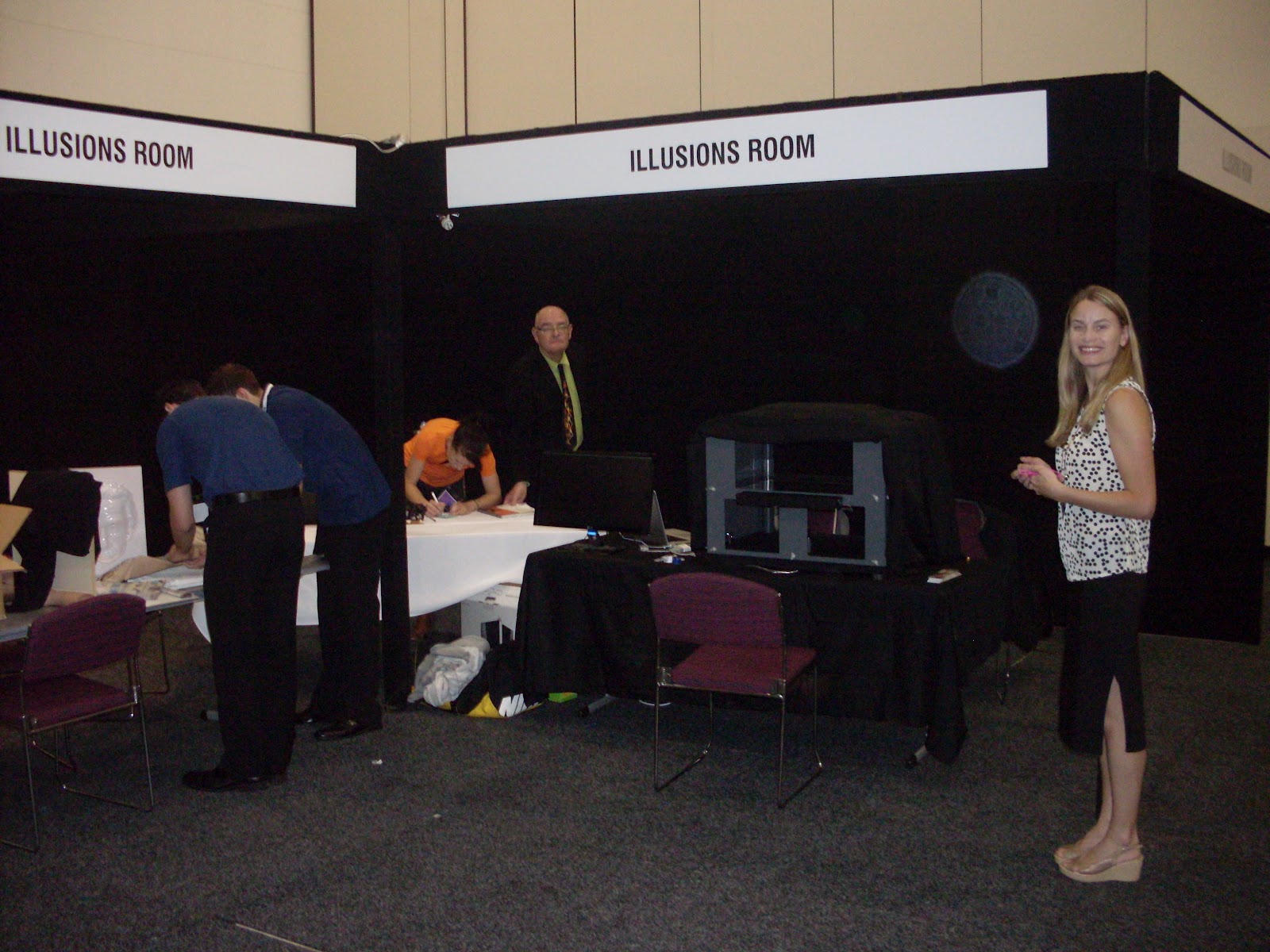
Dr. Tasha
Stanton and others setting up the Illusions room
My trip to Australia conveniently coincided with the NOI Neurodynamics
and the Neuromatrix conference 2012. This was an amazing event, and it was
great to see so many clinicians and scientists coming together to try to better
understand and treat chronic pain. Throughout my trip I worked with Dr. Tasha
Stanton to train up three physiotherapy students to use MIRAGE so they could
demonstrate it in the ‘Illusions Room’ at the conference. It went down better
than we ever could have hoped, with 45 minute queues to have a go on MIRAGE!
There were also a number of people with osteoarthritis who said that the
stretching illusion alleviated their pain – one of whom was completely unaware
of our ongoing research into the pain relieving benefits of MIRAGE. All in all,
the Illusions room was a fantastic success, so thanks very much to Andrew
Zacharia, Adrian Primerano, and Kris Krotiris, the physio students responsible
for making the whole event brilliant. Along with the rest of the Body In Mind
team, I also took part in the Ride for Pain - a community bike ride organised
by Lorimer Moseley to help raise awareness about chronic pain. It was a great day,
with over 550 riders showing their support. I’m ashamed to admit I opted for
the 35km beach ride, while most of the rest of the team completed the gruelling
100km ride through the Adelaide Hills. They all did so well, and if I manage to
make it out for next year’s ride I will most definitely be going all the way!

Riders from the "Ride for Pain" community cycle ride.
The trip was such an exciting opportunity and it was great
to work with such brilliant and passionate researchers. It has given me so many
ideas of where to take my future research, and is hopefully just the start of
some exciting future collaborations.
Written by Helen Gilpin
Tuesday, 15 May 2012
Disappearing Hand Trick Wins Illusion of the Year 2012
We are pleased to announce the fantastic news that the Disappearing Hand Trick won first prize in the Illusion of the year competition last night at the Philharmonic Center for the Arts, Naples, Florida. More to follow on this amazing evening when Roger gets back to England.


The disappearing hand Trick
For further details about the awards and the other nominees follow this link to view the competition website or New Scientist TV
Also check out one of our other illusions by following the links below
http://miragemultisensoryillusions.blogspot.se/2011/09/september-autumn-illusion.html
Also check out one of our other illusions by following the links below
http://miragemultisensoryillusions.blogspot.se/2011/09/september-autumn-illusion.html
Monday, 30 April 2012
Just another illusion box
The smallest man in the world tries out the University of Nottingham Malaysia Campus’ new MIRAGE, delivered and installed in person by Roger last week (it’s all in the service you know). The Malaysia version has a secret new component, making it suitable for certain kinds of brain imaging. More on that when the experiments are finished... Meanwhile, Helen has been using MIRAGE in Australia so hopefully we’ll have some pictures from that soon.

Written by Dr. Roger Newport

Written by Dr. Roger Newport
Wednesday, 18 April 2012
Thinking Outside the Box
The latest MIRAGE publication, which has just come out in Perception (Link), takes MIRAGE technology out of its box allowing us to stretch the whole arm opposed to just the hand a wrist, as well as viewing the body from 3rd person perspective. This opens up possibilities for many new illusions incorporating the whole body. So watch this space!

The arm stretching illusion
Figure adapted from Preston and Newport (2012) published in Perception.
Wednesday, 11 April 2012
Malaysia Grant Success.
Dr Kirsten McKenzie, from the School of Psychology at the University of Nottingham Malaysia Campus, has just been awarded a grant from Malaysia’s Ministry of Science Technology and Innovation to investigate somatosensory disorders and bodily misperceptions.
When we feel a sensation, such as pain, we assume it is caused by something happening to or within out body, but - there are many clinical cases in which an individual’s somatic experience is found to be a misrepresentation of bodily events. Most of the time our misperceptions are not a problem, and we are not aware that they have happened, but they can become problematic if, for example, we interpret normal bodily sensations as discomfort or pain.
Mistakes or misperceptions of bodily events are often associated with what are called Medically Unexplained Symptoms (MUS); situations in which patients experience what feels like very real pain or disability, but has no physical cause, and it has been suggested that MUS may account for up to a third of all visits to health-care providers. In this situation, it seems that there may be something wrong with the way the brain interprets information coming from the senses, but as yet very little is known about the processes underlying the development and maintenance of these misperceptions.
This study, which begins later this month, will use several new techniques, including the MIRAGE virtual-reality system in conjunction with Electroencephalography (EEG) to investigate when and how these illusory sensations are interpreted in the brain.
We are particularly interested in the time-course of these illusions. Whether these illusory sensations are generated at an early sensory processing stage, or at a later decision making stage will have a great influence upon both the understanding of sensory processing, and possible treatment options for MUS and somatosensory disorders.
Written by Dr. Kirsten McKenzie
Subscribe to:
Posts (Atom)